Perspective
Leading adaptive learning ecosystems for public health
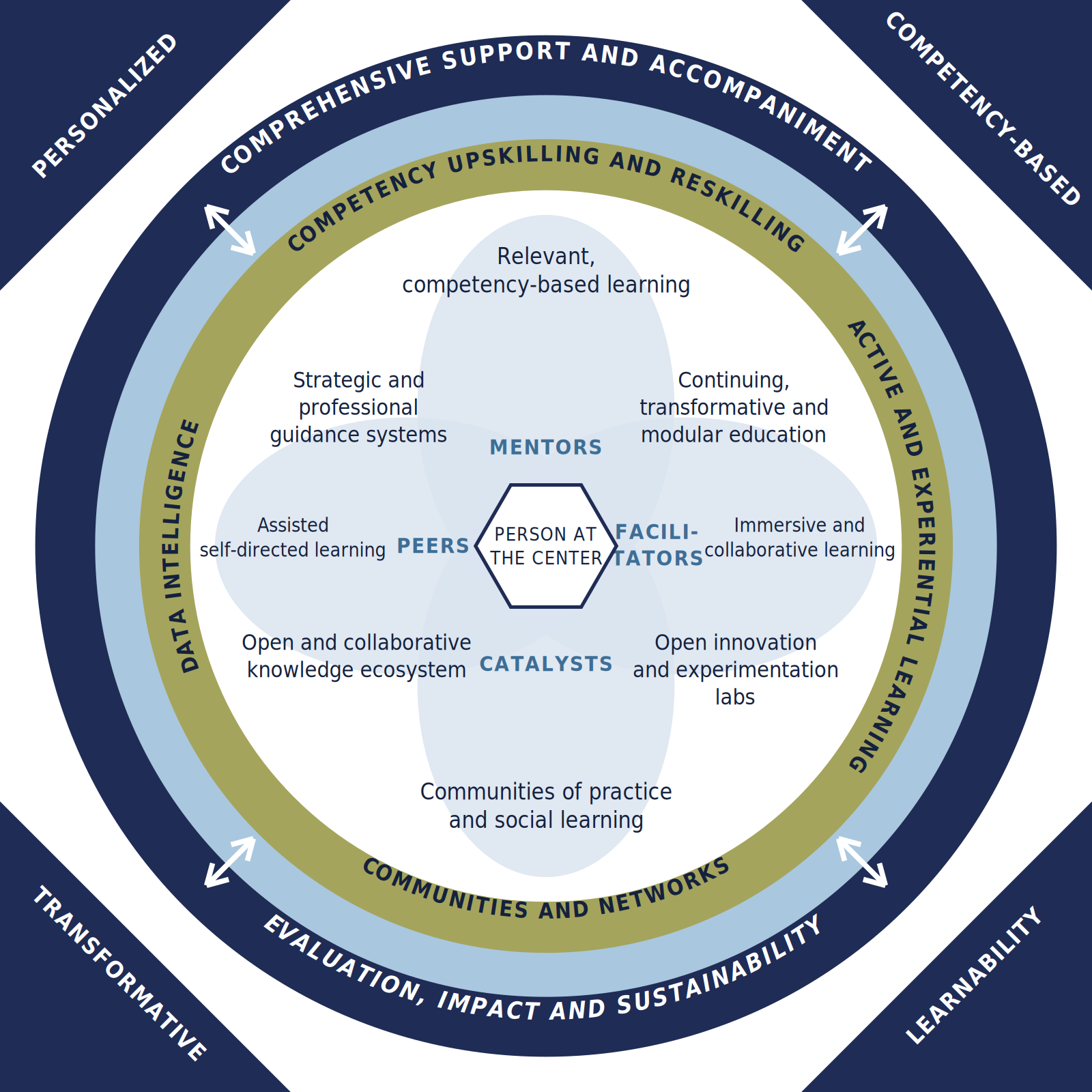
Public health education is usually renewed the way a curriculum is revised: course by course, competency by competency, accreditation cycle by accreditation cycle. That work matters, and it is no longer sufficient. Drawing on TLAHUI, a book written from the Escuela de Salud Pública de México for schools of public health internationally, this article describes what changes when a school stops behaving as a provider of programs and begins operating as an adaptive learning ecosystem. Four shifts carry most of the weight: learning has become liquid and no longer fits inside a classroom; personalization is becoming to education what precision has become to clinical care; the unit of change is more often a team or an organization than an individual; and the pedagogy itself, not only the syllabus, has to be redesigned. Underneath all four sits a condition that is easy to state and hard to meet, which is leadership exercised from values.
Keywords: public health education; adaptive learning ecosystems; workforce development; microcredentials; learning transfer; values-based leadership; TLAHUI
The view from the valley
Nature recently devoted a special feature to the future of universities (Nature, 2025). The cover imagined monumental academic columns lying broken across a desert, with people picking their way among the pieces, under a line to the effect that these institutions built the modern world and now have to survive it. Schools and programs of public health are not exempt from that picture. Financial models are fragile, administrative burden is heavy, artificial intelligence is unsettling both what we teach and how we teach it, and the wellbeing of faculty and researchers is under real strain.
The pressure that should concern deans most, however, is quieter than any of these. The problems our graduates will spend their careers on are being redefined faster than our programs can be revised. Climate and migration now converge into single events that require epidemiology, environmental science and humanitarian crisis management in the same person, or at least in the same room. Ageing, inequity, megacities alongside rural depopulation, digital transformation, and the erosion of trust in public institutions are not separate lines on a strategic plan. They interact, and they keep reshaping the work.
We opened TLAHUI (Saavedra Lara & Dalmau, 2026) on a mountain, because the image holds. From the valley you see what is coming toward you and how steep the climb is. From the summit you see routes that were invisible from below, and terrain that has not arrived yet. Institutions need both perspectives at once, and most of the strategic conversation in our sector still happens only from the valley. Read and Olcott (2025) make a similar case for universities generally, arguing that the moment calls for strategic and adaptive navigation rather than incremental adjustment.
Almost every school of public health puts leadership somewhere in its mission statement. In practice, technical leadership is not a claim; it is a position you occupy when ministries, health departments, agencies and communities turn to you for capability they cannot build alone. That standing rests on depth in social determinants, rigor in applied research, the ability to evaluate policy and its effects, and the capacity to train and keep training the workforce. Increasingly it also rests on something less traditional, which is the ability to convene others around a problem.
There is a simple diagnostic we use for this, and it takes an afternoon. Take the school's full portfolio of degrees, certificates and continuing education and map it against the strategic priorities of the health authority you serve. Where the map is dense, you are a lever. Where it is empty, you are a catalogue. Most schools discover both at once, and the empty cells are usually the interesting ones. The renewed framework for the Essential Public Health Functions in the Americas (Pan American Health Organization [PAHO], 2020) makes the same argument from the system side: EPHF 6 asks explicitly for continuously updated competencies, for competencies that did not exist in the old professional profiles, for collaborative and intersectoral skills, and for the preparation of trainers. The instrument the region has for delivering all four is the school of public health.
Learning has become liquid
One of the more useful ideas in health service redesign is hospital at home: rather than move the patient to the institution, move the institution's capability to the patient. Learning is going through the same inversion. Rather than bring professionals to the training, bring the learning to where the professional already is.
That sounds like a slogan until it is made operational. It means microlearning released when a protocol changes, not six months later inside a course. It means performance support embedded in the tools people already use, so that guidance appears inside a surveillance system, an intelligent checklist or an assistant sitting beside the workflow rather than on a separate platform. It means communities of practice in which professionals work on real problems together, as the Catalan Public Health Agency has done, and it means treating structured reflection as part of the job, with after-action reviews at the close of an outbreak response or a program rollout. This is the territory Bersin (2022) describes as learning in the flow of work, where the job itself becomes the primary learning environment. It also means open, self-directed access at scale, which the ESPM's CLIMA platform, PAHO's Virtual Campus and the WHO Academy already provide.
Liquid learning changes what graduation means. If a professional works four or five decades, the degree marks a transition rather than an end, and the school's relationship with that person becomes orientation, learning, application, practice, new challenge, new learning. Alumni then stop being a fundraising category and become an early-warning system: the people best placed to tell you which competencies are being demanded now, in a health department three states away or in another country, long before that signal reaches a curriculum committee.
Personalization is the educational counterpart of precision
Public health has spent two decades learning to stratify, using genomic, biomolecular, clinical, behavioural and environmental data to prevent, diagnose and treat with more precision. Education is arriving at the same place from behind. Our default has been one program for an entire cohort, with the same sequence, the same pace and the same evidence of completion. What is becoming possible is a differentiated route for each person that still adds up to a coherent qualification.
What makes this work is not the technology but the data a school decides to treat as meaningful. In TLAHUI we call these learning biomarkers (Saavedra Lara & Dalmau, 2026): the signals that reveal where someone is actually struggling. Patterns of error in an activity, the points where people slow down, the concepts that get revisited, the assignments that never make it into practice. Read well, they let a system recommend a resource, connect a participant to a peer or a mentor, adjust the difficulty of a case, or flag early that someone is about to disengage. Paired with a dashboard the learner can see, this turns learning analytics from institutional reporting into something a professional can use.
The most interesting borrowing here is prevention. In public health we do not wait for disease to appear before acting on risk, yet in education we almost always wait for a gap to appear before designing the course. Competency maps, professional profiles and curricula can be built the other way round, anticipating obsolescence rather than remediating it, and alumni networks and labour-market data are the sensors that make that possible.
Artificial intelligence accelerates all of this, and it is worth being precise about its role. A school can adopt generative AI across its operations and leave its educational architecture exactly as it was. Bias, privacy, over-reliance and the risk of widening rather than narrowing equity gaps are real and need governing. But the question worth putting to a leadership team is not what the tool can do. It is what the institution can now understand and enable that it could not understand or enable before.
Individuals learn; systems change when teams do
This is where most learning strategies quietly fail. We design for individuals because individuals enroll, and then we are disappointed that practice does not change. The people who actually deliver public health work in natural teams: a district surveillance unit, a primary care center, a program office. Increasingly those teams include roles that barely existed a decade ago, with data scientists, process engineers and clinical administrators working alongside epidemiologists, physicians, veterinarians and ecologists. Planetary health did not make our problems interdisciplinary. It made it impossible to keep pretending they were not.
Designing for teams is not the same as designing for individuals who happen to share a classroom. It means cohorts drawn from the same unit rather than from the same profession. It means challenges taken from that unit's real workload. It means interprofessional simulation, in the spirit of TeamSTEPPS (Agency for Healthcare Research and Quality, n.d.), where the object of learning is the coordination itself rather than the individual technique. And it means being honest that coordination is not integration: a program in which each discipline presents its own perspective in turn has integrated nothing.
The organizational level asks for a further step, which is a different contract with employers. At ESPM we have been building dual microcredentials together with hospitals, primary care networks and health authorities, using a design we describe as 10:20:30:40, built on Charles Jennings's idea of levels of integration between learning and work (70:20:10 Institute, n.d.). Roughly a tenth of the effort is self-directed, a fifth is social and collaborative, three tenths are experiential through simulation and scenario practice, and the largest share, four tenths, is spent applying, evidencing and validating the competency in the real work setting, supervised by practising professionals and assessed with rubrics rather than essays. The resulting credential is not two certificates stapled together. It certifies that academic learning and professional validation happened as a single process, and it positions the school as a partner in workforce development rather than a supplier of courses. European policy has been moving in the same direction, defining micro-credentials by the learning outcomes they validate and the assessment behind them rather than by their duration (Council of the European Union, 2022).
That final 40% is where transfer lives, and it is where most programs stop. What determines transfer is not mysterious. It depends on the motivation of the individual, on whether the organization has the processes and resources that allow a new practice to exist, and above all on whether the person's immediate manager supports it. A school cannot control those variables, but it can design around them: involve supervisors from the outset, place the improvement project inside the program rather than after it, give managers rubrics and templates they will actually use, and follow up at thirty, sixty and ninety days. Mentoring, peer learning and internal experts extend the program past its last session, which is precisely when the interesting part begins.
There is a mirror image of value-based health care in all of this. Value-based care measures outcomes that matter to patients rather than volume of activity. Value-based education would measure application and its effects rather than enrolments and completion rates, and it would be willing, as Catalonia's Essencial project has been on the clinical side (Departament de Salut, Generalitat de Catalunya, n.d.), to name the practices that add no value and stop doing them.
New ways of teaching, not only new content
Schools of public health teach challenge-based learning, co-creation and experimentation more often than they practise them. Innovation laboratories are a practical correction. Rey (2024) distinguishes three depths: learning labs, where the measure of success is what participants develop rather than whether the problem is solved, and a hackathon is a recognisable example; acceleration labs, which turn a public health challenge into a working prototype; and impact labs, which carry a prototype into implementation and iterate it. These are not three units to build. They are three levels of ambition to choose between, challenge by challenge.
Simulation deserves particular attention, because it lets us teach what cannot otherwise be rehearsed. Managing a cholera outbreak in a refugee camp, deciding under incomplete information during a crisis, negotiating across sectors when the evidence is contested: these are the situations where public health professionals actually fail, and they are almost absent from formal curricula. Digital scenarios, branching cases and virtual laboratories make them repeatable, and they make failure safe.
None of this survives contact with a faculty that has not been prepared for it. Investment in educators, in facilitation, in assessment design, in the pedagogical use of AI, is the constraint that most often determines whether an innovation spreads or stays inside one enthusiastic department. So is psychological safety. Hamilton (2019) identifies fear, assumption, technology and environment as the four things that suppress curiosity in a team, and Ashcroft, Brown and Jones (2020) place trust at the centre of their seven conditions for it. Curiosity requires permission to ask the obvious question and to run an experiment that may not work, and where errors are punished, experimentation simply stops being reported.
Values-based leadership is what turns purpose into transformation
Everything described so far is achievable. Whether it happens depends on a small group of people, and in most schools they are not the deans. They are the directors of continuing education, of academic innovation, of learning and development: the people who decide what gets designed, what gets funded, and whose expectations get challenged.
In TLAHUI we set out this leadership across four dimensions (Saavedra Lara & Dalmau, 2026), from the personal, which supplies the why, through people and teams, which supplies the with whom, and the organization, which supplies the how, to an aspirational dimension oriented toward the environment, which supplies the for what. Within them we identify eight activators, and it is worth noting where they begin and end. They begin with integrity, ethics and values, and they end with shared purpose. Everything technical sits in between.
This is not a decorative point. A leader who asks a faculty to experiment while punishing failure has already answered the question. So has one who commissions a transformation plan and protects no time for it. The philosopher Francesc Torralba writes about an ethic of vulnerability in leadership (as discussed in Saavedra Lara & Dalmau, 2026), and its practical content is unglamorous: a leader who can say that they do not know, that they need help, or that they were wrong, makes it possible for everyone else to learn in public. In an institution whose product is learning, that is not a soft skill. It is the operating condition.
The World Economic Forum's Future of Jobs analysis (World Economic Forum, 2025) places resilience and agility, curiosity and lifelong learning, creative thinking, technological literacy, and leadership and social influence among the capabilities rising fastest in importance toward 2030. Schools of public health will be teaching all of them. The uncomfortable question is whether the institution doing the teaching would score well on the same instrument.
Five questions for a leadership team
- If we mapped our entire portfolio against the strategic priorities of the health authority we serve, how much of it would land on the map?
- Where does learning already happen in our system that we neither design for nor recognise?
- What evidence do we hold that anything we taught last year changed a practice, a team or a health outcome?
- Who in our institution is allowed to run an experiment that fails, and what happens to them afterwards?
- Would our own school pass the assessment of adaptability that we apply to the professionals we educate?
The cave and the clay
TLAHUI ends where two landscapes meet. A few kilometres beyond the mountains of Tepoztlán lies Tlayacapan, a town known less for its sixteenth-century monastery than for its clay, and for a community of potters who have spent generations giving form to it. On the other side of Montserrat, in Manresa, is the cave where Ignatius of Loyola spent eleven months of convalescence observing his own experience closely enough to write it down, in notes that eventually became the Spiritual Exercises.
Two places, two cultures, one message for the people who lead our institutions. Transformation needs a protected space in which to think, honestly and with your team, about where the school actually is and what it is for. And then it needs clay, because reflection that never takes physical form is just a document.
Our recommendation to colleagues is deliberately modest. Do not try to transform the whole school at once. Choose one priority initiative, design it properly, involve the people who will have to live with it so that it becomes theirs, implement it, and learn from what happens. Then document the results, publish them, and share them with other schools, because we learn from what others have been generous enough to share.
The name TLAHUI comes from the Nahuatl figure of the lord of dawn, the moment when darkness gives way to light and a landscape that was there all along becomes visible. Schools of public health are standing in that light now. The degrees will remain, the faculty will remain, the research will remain. What changes is the architecture around them: continuous rather than episodic, connected rather than contained, adaptive rather than fixed, and measured by what people were able to do afterwards.
A school of public health that can learn continuously may be one of the strongest instruments a society has for transforming itself. That is worth more than any program we could add to next year's catalogue.
References
- 70:20:10 Institute. (n.d.). The 70:20:10 framework. https://702010institute.com
- Agency for Healthcare Research and Quality. (n.d.). TeamSTEPPS: Team strategies and tools to enhance performance and patient safety. https://www.ahrq.gov/teamstepps-program
- Ashcroft, P., Brown, S., & Jones, G. (2020). The Curious Advantage. Laïki Publishing.
- Bersin, J. (2022). A new strategy for corporate learning: Growth in the flow of work. https://joshbersin.com
- Council of the European Union. (2022). Council Recommendation on a European approach to micro-credentials for lifelong learning and employability. Official Journal of the European Union, C 243/10.
- Departament de Salut, Generalitat de Catalunya. (n.d.). Essencial: Adding value to clinical practice. https://essencialsalut.gencat.cat
- Hamilton, D. (2019). Cracking the Curiosity Code. Dr. Diane Hamilton.
- Nature. (2025). The future of universities [Special feature]. https://www.nature.com/immersive/d41586-025-03086-5
- Pan American Health Organization. (2020). The Essential Public Health Functions in the Americas: A Renewal for the 21st Century. Conceptual Framework and Description. PAHO. https://iris.paho.org/handle/10665.2/53125
- Read, T., & Olcott, D., Jr. (2025). Mobilizing university futures: A blueprint for change. https://doi.org/10.1177/14782103251341405
- Rey, A. (2024). Tres tipos de laboratorios de innovación: del aprendizaje al impacto. https://www.amaliorey.com
- Saavedra Lara, N., & Dalmau, O. (2026). TLAHUI: Transformación y Liderazgo para la Innovación del Aprendizaje en Salud Pública. Escuela de Salud Pública de México.
- World Economic Forum. (2025). The Future of Jobs Report 2025. WEF.
Author note. This article develops ideas presented in TLAHUI (Saavedra Lara & Dalmau, 2026), published by the Escuela de Salud Pública de México. Figure 1 is adapted into English from the original model published in the book.
Volver a Notas